
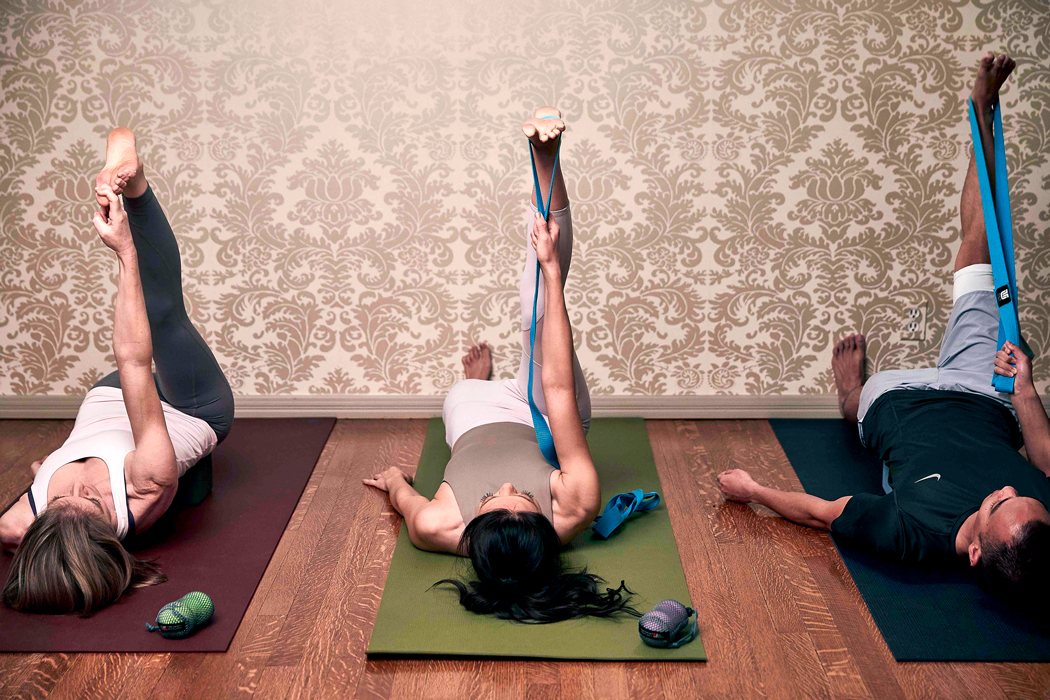
The recent Dynamic Aging: Moving Well with (or Without) Joint Replacements weekend immersion at 1440 Multiversity was sold out, with a looong wait list. For good reason.
Word is out on the importance of joint health for posture, movement and the structural support necessary for all of your inner systems to run smoothly as time marches on.
The Dynamic Aging program was led by Tune Up Fitness® creator Jill Miller and Nutritious Movement® founder Katy Bowman. Jill and Katy have both built their life’s work around sustainable, self-care based practices. Practices that are designed to empower the general public to take health and longevity into their own hands… and bones.
As friends and co-conspirators for the wellbeing of humankind, they decided to join forces on the topic of joint health for “Dynamic Aging” (which is the name of one of Katy Bowman’s books).
You may have missed the weekend, but below you’ll get some highlights from Jill Miller on how to maintain ‘springtime in your joints’–the ability to keep them supple, strong and maybe even youthful… so you can continue playing your way through life despite normal physical wear, tear and setbacks.

1. How does joint health relate to overall physical health?
“Your joints either grant you range of motion or they limit your range of motion,” shares Jill. “Your soft tissues that surround your joints are designed inherently to have a certain length/tension relationship. Retaining that relationship optimizes function.
“So when muscles or soft tissues stiffen because you’re not taking your joint through range of motion, then we start to have pathologies to those tissues.”
What does this look like in daily life?
“It could be simple as ‘I have neck pain because I’m not fully rotating my neck to the right and left… I’m not extending and flexing my neck on a regular basis–because I’m just staring at a computer screen… and you start to have aches and pains that are a part and parcel of not mobilizing those joints. The neck is an easy one to see because many people have complaints in there–the back of their neck, upper traps, jaw pain–related to not utilizing full range of motion of the joints.”
2. For those who want to prevent long-term joint degradation issues, what would you recommend?
“Make sure you’re brushing and flossing the joints in your body,” offers Jill. “Which means you’re taking them through range of motion in all the different ways they’re meant to move. Do that both in a dynamic strength manner, isometric strength, different modes of stretch, and in marshaling the mobility of the soft tissues in and around the joints by using our therapy balls. Use therapy balls to massage the tissues that are a part of the joint complex.”

How does all this improve your joint function?
“Your joints have extrasensory powers with the type of mechanoreceptors located there. So there’s an accrued benefit to addressing the language of your joints, to addressing their articulations in all of these different ways. That will ensure that you maintain the mobility that nature has designed for your body for this lifetime.”
Um. That’s awesome. Do most fitness systems address this depth of joint care for our bodies?
“Your body is your body whether you’re putting it into CrossFit or yoga or pilates or doing triathlons. Each of those systems, while they might market themselves as complete, has a bias toward different aspects of joint motion and joint mechanics. So you want to cross-train your joints.”
3. For those who are starting to feel joint pain, what do you recommend?
“There are different types of joint pain because there are different types of joints,” explains Jill. “I think when people are thinking of their ‘joints’ they’re most often thinking about hips, shoulders, knees, hands and feet–highly moving joints.
“When we have joints that have a high amount of synovial fluids that’s a part of the joint capsule, that synovium is hyaluronan–that hyaluronan is produced through movement. Movement produces the oil slick in your joints. So if you’re not moving much, there is a reduction in that fluid. Then your bones don’t glide as well and can cause friction, which precedes joint disease like arthritis.”
Oh, bummer. So how does movement fit in again?
“Movement is just so critical for the health of joints,” says Jill.
“Then there’s [also] too much movement. Too much hyaluronan and too much repetitive action in the joints reduces the health of the cells that produce the hyaluronan because those tissues are getting overused and exhausted. So there’s a problem with degradation of hyaluronan and that ends up becoming a condition where the bone no longer has its right protection.
“So too much movement or too little movement affects the fluid environment of the joint.”
Got it. And what about if the joint isn’t in pain, but clicks or just feels funny? Did you have pain before your hip replacement?
“Not hurting doesn’t mean no problem,” shares Jill.
“The “owey” kind of pain isn’t the only warning sign–and this takes us into the biopsychosocial model of pain–because I didn’t have pain. My hip joint was never painful. It was a muscle called the tensor fasciae latae (TFL) that was the ‘canary in the cole mine’ that I would have infrequent spasms in for the seven years preceding me getting the MRI.
“I’d have spasms in TFL at night–it was trying to hold the hip together. Or I was overusing it during the day as a main hip flexor rather than accessory.”

4. For people who have a joint surgery coming up, what do you recommend to help them prepare?
“I think one of the most important things for [a healthy post-surgery] recovery is ‘pre-covery’” offers Jill. “When you know you are going to go under the knife is not the time to just let your body go weak and not do anything. You want to make sure that you are trying to stay as strong as you possibly can in the muscles that surround your joint and in your whole body, so you have very good blood flow going into surgery.”
That makes a lot of sense. Is this what you did leading up to your hip replacement?
“I lifted weights the day before I went into surgery and I was not crippled by my issues. Many people, as they go into surgery are functionally so unhealthy because of the pain in their joints. But as much movement as you can muster is critical in the pre-recovery stage. I would encourage people to do as much as they feel that they can do leading up to it.”

5. For those who recently had major joint surgery, and want to participate in their own rehab, how can they make the new joint as healthy as possible moving forward?
“It’s important to listen to movement precautions of surgery,” says Jill. “You will get a sheet and you really need to respect that because it has to do with the type of prosthesis that is given–the replacement or whatever other type of surgery you had. Those precautions are critical–especially in long term. You will want to share them with every single movement instructor or clinician that you encounter so that you’re safe in the context of exercise and movement.
“Get empowered by getting informed. If you’ve had any surgery of any kind and you don’t know what those movement precautious are, you should go back and look at the record.”
How will knowing the precautions help people who’ve had major joint surgeries in the past?
“This information will empower you to not live in fear of your body and fear of what you can and can’t do,” states Jill. “Then when you are able to communicate about those precautions to the experts that you’re relying on for programming and movement it’s very freeing.
“This is something I come across again and again–people don’t know their movement precautions. As their teacher I do not want to carry that burden. They need to figure that out.”
Katy Bowman often talks about how you ‘wear your body’. Jill encourages people with joint replacements to also ‘wear the prosthesis with integrity’.
“There are decades and decades of adaptations that happen to your body while you’re wearing out a joint leading up to needing a joint replacement,” Jill continues. “Conditions in your body that are making that joint bear the brunt of forces and its deterioration. Then there are the years post-op where you’re also wearing yourself in a new way. And if you’re never taught some fundamentals of movement you’re very likely to just go back into the pattern that got you there in the first place.”
This is why both Jill and Katy recommend bringing plenty of healthy movement back into play for people who have finished working through doctor-prescribed PT protocol after a surgery. This way the miracle of modern science can support you moving into the future with confidence and possibility.
Upon reflecting on her own hip surgery, Jill shares, “I have a second chance to live in my body in a new way.”
Let the dynamic aging begin.
You want to dig deeper into self-care fitness and self-massage practices? Check out the Tune Up Fitness® Hips Immersion Training and dedicate three days to refining your embodiment of the pelvis, hips, legs, knees, ankles and feet.
Author: Ariel Kiley
Related Article: Surprise, Surprise! You need a Total Hip Replacement!
Learn more about our Therapy Ball Products and Programs
Interested in video and blog content targeted to your interests?

I am obsessed learning about sustainable movement, movement longevity, and improving quality of life as we age. I can relate to this article as I was a competitive figure skater growing up as a child. University introduced me to a much more sedentary lifestyle. I went from mobile and strong, to weak and was stiff everywhere. I jumped into dance. Fell in love with yoga. Became stronger and more flexible. But I still had injuries. I need to cross train in order to dance injury free. I needed to implement a self-massage routine into my warm-ups and cool downs. I needed strength and conditioning classes to maintain stability in my joints and body, with the new ranges of motion and flexibility I was creating in my body.
Now I am replanning my health and wellness goals as the ones I had before were not sustainable. I would be broken by the time I am 50 if I continue working out and practicing this way.
Thank you for this insightful and informative read.
bonjour, je ne connaissais pas le terme mécanorécepteur, très instructif !
Thank you for mentioning the idea of “cross training” as a way to diversify the way we train our joints. I appreciate this as a dancer and dance educator who is trying to bring this into my own teaching. It is also amazing how our joints have these “extra sensory powers” which really help us to explore our range of motion!
As an RMT, I see so many people under the age of 50 who are not moving their bodies daily in any form and seem so eager to blame pain and discomfort on age or age related deterioration. Education and awareness around the health of joints seems to be something that could be beneficial at any age so that we are able to be proactive toward our joint health as we age.
I will be recommending this item to some of my clients. This article helps to understand that we are responsible for our quality of life and the well-being of our whole body.
It’s a shame that most people wait until they have suffered an injury before taking care of themselves. As a yoga teacher, we are here to educate them in this direction.
I like it when you say for preventing joint degradation issues “Make sure you’re brushing and flossing the joints in your body “. This is something I learned from my YTU training and this major.
I recently completed my Yoga Tune Up® certification training and I am amazed how integrating joint mobility exercises in my practice got that synovial fluids moving! My joints used to crack all the time, not anymore! I find the Pranic Bath particularly useful for the shoulders and the Prasarita Lunges particularly useful for the hips. Thank you for bringing awareness to my body’s needs and to empower me to take care of it!
Yoga Tune Up® Pranic Bath
https://www.youtube.com/watch?v=FjzXfQW-UAw
Yoga Tune Up® Prasarita Lunges
https://www.youtube.com/watch?v=vlRluk8Uc2g
This article talks to me a lot,….
“Your body is your body whether you’re putting it into CrossFit or yoga or pilates or doing triathlons. Each of those systems, while they might market themselves as complete, has a bias toward different aspects of joint motion and joint mechanics. So you want to cross-train your joints.”
With my YTU training, I am starting to change many things in my life; I feel like I am investing in my future.
🙂
Thanks for the insight. I have been struggling with neck pain and my solution is to not move it if it hurts. I am going to try as you say to play with range of motion and bring a bit more movement to my neck in a respectful way. Thanks for the inspiration!
What an inspiring article! Thank you for sharing!
This is a great article that explores the balance in between overdoing things and not doing enough. I tend to be on the side of overdoing things and it was interesting to note that is just as bad as not moving enough. Like everything there is a fine line. It was helpful to have both sides of that line explored and explained. Thanks for sharing!
So important to educate people that you can do both too much and not enough. See so many people go to the extreme with strength training and then when they want to loosen up they go to the extreme of mobility and stretching. I keep telling those who come to my classes you deed to do both when you want to get balance.
I love the concept of ‘dynamic aging.” I’m lucky enough to work with a movement coach who incorporates much of what you write about here. Working with him, and with your therapy balls has helped me, at age 58, feel healthier in my body than I did when I was decades younger. And because of this work, I know that pain is not an inevitable consequence of aging.
Really important to stay active and keep moving, but also knowing limitations and precautions. I was anxious to return to the gym and yoga after my hip replacements — I remember it taking time, baby steps and needing to be patient. My return to full ROM has been wonderful. Thanks for sharing.
“Brushing and Flossing the joints” is a concept I cannot wait to share with my students. Everyone understand the importance of brushing and flossing their teeth. Now we know it is critical to the health of our joints.
Joints can create stability and mobility, we want to train our joint smart so the joints need to be stable are stable, the joints need more mobility can become more active, we are students of our own body, so always observe our own body, what we need, what can help us feel better, what helps us prevent pain and release pain are so important for long term joint health.
So important to keep moving but is so important to do it with awareness and understanding of our bodys… the problem is that many of us have learned in the opposite way, fancy poses first, after a while pain or injuries, and then finally we learn how to move!!!
I’ve had the discussion about whether to have older populations live in a place with stairs vs. without stairs. We often think that having a set of stairs can lead to injuries due to the possibility of falling. On the other hand, having a staircase provides an opportunity to work on range of motion in your hips and knees and strengthen the glutes. And this article made me think of the stairs argument…
Nice article, practicing taking joints through full range of motion has been super helpful in my own body
When we feel pain around shoulder ,or any part of body , we do have tendency
thinking of only pain, not related to the joint close to body which are painful.
It is a good point, the joint mobility is a way of maintain good health.
The verbal imagery of “brushing and flossing the joints” serves as a wonderful reminder that this needs to be a daily adventure. I’m grateful for YTU therapy balls and this community for shining attention on self-care.
I like the idea of cross-training your joints. Taking the body through different modalities of exercise will allow for a variety of range of motion. So vital for optimal health.
Your joints and tissues will adapt to your body’s needs during activities and will alter themselves accordingly. We need to be cognizant of the demands we’re placing on our bodies and address those needs with supplemental work like the use of therapy balls.
This is something I’ve been thinking about a lot lately. How can I move my body so that when I get older my joints and ROM are in good shape? Cross train and floss your joints! I learned so much reading this article. Thank you!!
Love learning all about joints in our bodies. We need to have a variety of movements in our days and weeks. We might love yoga, but doing the same poses over and over again might not be so beneficial to us. Following interesting and knowledgeable teachers on Instagram can spark ideas to mix it up and allow us to take care of our joints.
I appreciate the suggestion to address the language of your joints, as most of society is addressing muscles and have overlooked the value of our joint health. Addressing and exploring the full available range of motion in our joints, or finding where we have lost some of our ROM can be extremely valuable to our longevity. I am getting more curious and explorative with the YTU therapy balls and this learning is invaluable to me.
I like that axiom “cross train your joints”. It’s alarming to consider there might be problems in a joint without any (or much, or direct) pain. I’m waiting to pick up Katy Bowman’s book Dynamic Aging from my library. Will definitely come in handy for teaching yoga to older populations.
Interesting to learn joints may need replacement without causing the ouch kind of pain. It is certainly important to continue strength and mobility activities up to the surgery. I only wish more people would take and use that advice.
We are responsible for our health is so important to remember.
Thank you Mrs Miller
Very interesting the appearance of hyaluronan which increases with the movement. This argument will convince my clients to further strengthen their peri-articular musculature and prevent postoperative deterioration.
Many Ways to cure and to prevemt problems with joints … I will include theses routines daily thanks
Let the dynamic aging begin.Wow!
It’s important to be aware of our body, flexibility and mobility. All this requires good joint health. It’s important to take care of it. Thanks for sharing these few tips. Very interesting.
Thank you, very intersting this article. We need to move but smartly and using the right tools like self-massage balls!
Very interesting usefull to understand nécessite of movement on body structures for better Health
Thanks
It’s important as movement teachers and students that we examine the biases of our practice. Yoga as a modality explores large degrees of motion at end range. This can be valuable since end range is one of the many degrees of motion that we want to have mobility. But using the joints in smaller ranges is critical as well. It creates greater resiliency of our tissues. I think that it’s vital that we critical engagement with our movement (or lack of it) in all areas of our lives whether we are at the gym, on the yoga mat, or at home. We need to keep asking, to use Katy Bowman’s phrase, ‘is my movement nutritious?’
Moving the joints in all the directions they are meant to move has become one of the ways I warm-up my students for their yoga practice. In fact, sometimes I just want to spend the whole class “warming-up!” The YTU training has given me encouragement to create a class moving in that direction.
Thanks for the information! I am only 36 years old and two years ago I started to experience pain in my joints. I believe this is from a very sedentary lifestyle. Now my struggle is finding the balance between progress and injury. I am very optimistic. I believe that the body (and the joints) has the ability to heal.
Our joints, yes we need to add movement and self care. One of the things l have come to notice about my body, it loves the yoga tune up balls and l do use them and l feel better each time. Thank you Jill .
This is a great article, it’s very important to move a lot and strengthen our bodies, As we get older, we loose a lot of that joint mobility and we are prone to fall. Using those balls helps us in joint stability.
ITS VERY CRITICAL TO MOVE OUR BODIES IN A WAY TO FUEL OUR JOINTS SO WE CAN PREVENT FUTURE INJURIES. AS WE GET OLDER, SOMETIMES WE JUST BECME LAZY AND THAT LEADS TO FRAGILITY AND BECOME PRONE TO LOTS OF ACCIDENTS.
I love the idea of “addressing the language of your joints” and particularly the imagery of “brushing and flossing” the joints. It’s an important reminder that in order for your joints to be healthy, you must take them through all of the different ranges of motion they’re meant to move. If you don’t use it, you lose it! And if you can learn and understand the language of your joints, you’ll likely feel more empowered and in charge of your own body and what its capable of.
I agree that it’s very important to learn how to prepare our bodies and get strong before any surgery or a big change in our body. Often takes longer to recuperate and get back to your “normal” because we don’t know how to do it and often we don’t ask the right questions. We often believe that after a surgery we should rest and don’t move. All the contrary we should start to move as soon as possible to help our body to recuperate faster.
I am in the Yoga Tune Up Certification course now and have just realized that I can move my shoulders in ways I decided years ago I couldnt. A bit of fear in the pain. But now, gone. This is another wonderful article and so very informative. I love learning about all the directions of space you hold. Thank you.
Blessings
Melaina
Brushing and flossing the joint is very helpful. Thanks.
My husband just had a total knee replacement 2 weeks ago and he is recovering much faster because of his preparation before the surgery and continuing with rehab. He is also incorporating YTU in his routine now.
I’m a Nutritious Movement RES and long time Jill fan. About time to follow her blog!
I’m a Nutritious Movement RES & a long-time fan of Jill. About time to follow her blog!
I am going to share this post with my class of “dynamic agers”. The recommended self care for joints and mobility aligns so beautifully with yogic principles of drawing attention inward, honesty, self study, and creating a practice from the inside rather than hitting a “pose”. Thank you for laying this out so clearly!